PANEL
Beyond Firewalls: Is Cyber Resilience the Only Real Defence?
DAY 2 / 11:15 – 12:15 / MAIN HALL
Traditional perimeter defence cannot withstand geopolitical shocks, hybrid threats, or supply chain disruptions. In today’s complex world, resilience is the new baseline, but it must be part of a broader, layered defence strategy. This panel will convene experts from government, defence, and industry to discuss evolving security postures. The focus will be on shifting from perimeter protection to layered approaches, enabling organizations and states to anticipate, absorb, and recover from disruptions, with insights on cross-sector collaboration and emerging cybersecurity technologies.
Speaker

United Kingdom
Steven
Brown
Vice President, Cybersecurity & Threat Intelligence, Mastercard Europe
Steven Brown is Mastercard’s European lead for Cybersecurity and resilience services. He is responsible for the implementation and integration of Mastercard’s Cybersecurity capabilities including data breach detection, cyber risk and threat intelligence technologies across all related stakeholders.
Steven drives strategic relationships with both private and public sector parties, working with Enterprise C-Suite Level Executives to understand the needs of customers and the technology required to detect and protect customers from cyber and systemic risk. Steve also works with key interlocutors to drive legislative and regulatory compliance within cyber security and supply chain risk management.
Prior to joining Mastercard, Steve was a Senior Manager at the UK’s National Crime Agency where, as Head of Cyber Threat Intelligence, he led the UK’s strategic response to Cyber Crime.
During his 17-year career within UK Government, Steve also served as the UK’s Cyber Attaché to the USA during 2016–2019, embedded with the FBI Cyber Division at National Cyber & Forensics Training Alliance (NCFTA). Steve was responsible for diplomatic and political relationships and negotiations relating to the investigation of cyber criminality affecting the UK and USA.
Speaker
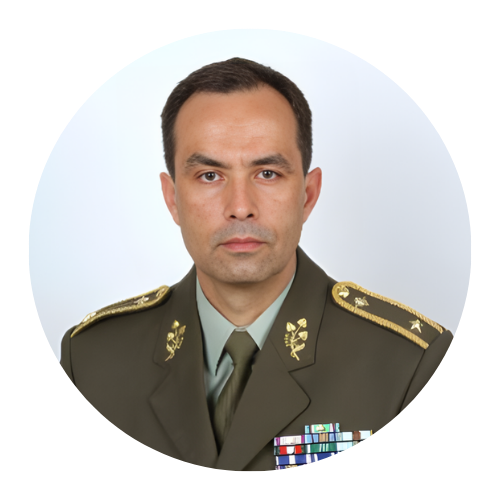
Czech Republic
Brig. Gen. Radek Haratek
Commander of Cyber and Information Operations
Brigadier General Haratek is a graduate of the College of Information and Cyberspace (CIC) at the National Defense University in Washington, D.C., USA. Over the course of his career, he has served, among other roles, as Deputy Commander of a Special Forces company within the combat units of the 6th Special Forces Group, Head of the Planning Division of the 601st Special Forces Group of Military Intelligence, and Deputy Chief of Staff of the 601st Special Forces Group.
He has also served in Mons, Belgium, as a specialist with the Special Operations Office at SHAPE and the NSHQ SHAPE, and in Afghanistan as Commander of the Czech Armed Forces Task Force – PSU Logar mentor unit (TF ACR RS – PSU Logar).
In 2019, he became Chief of the Operations Department at the Headquarters of the Cyber and Information Operations Command, and since 2023 he has served as the Commander of Cyber and Information Operations.
Speaker

Poland
Kasia
Chojecka
Head of Government Affairs Poland & CEE, Cisco
Head of Government Affairs for CEE at Cisco Systems. Member of Management Board of Digital Poland Association. Co-Chair of Digitization Committee in Amcham. Assistant Professor at Warsaw University of Technology.
Speaker

Canada
Josh
Kilberg
Senior Director of Threat Assessments, Reporting & Planning, Canadian Centre for Cyber Security
Joshua Kilberg is Senior Director for Threat Assessments at the Canadian Centre for Cyber Security, a part of the Communications Security Establishment. He has more than a decade of experience working in security and intelligence.
Speaker

Ukraine
Ihor
Malchenyuk
Strategic Advisor, Cossack Labs
Moderator

Alexander Leslie
United Kingdom
Senior Advisor for Government Affairs, Recorded Future
Alexander Leslie is a Senior Advisor for Government Affairs at Recorded Future, where he works with public-sector stakeholders around the world to apply cyber threat intelligence to national security priorities. He previously served as a senior threat intelligence analyst with Recorded Future’s Insikt Group, researching cybercrime and cyber-espionage ecosystems, as well as the ways in which geopolitical developments shape adversary behaviour in cyberspace. His work focuses on the intersection of cybersecurity, geopolitics, and U.S. national security, including the policy implications of emerging-technology abuse.